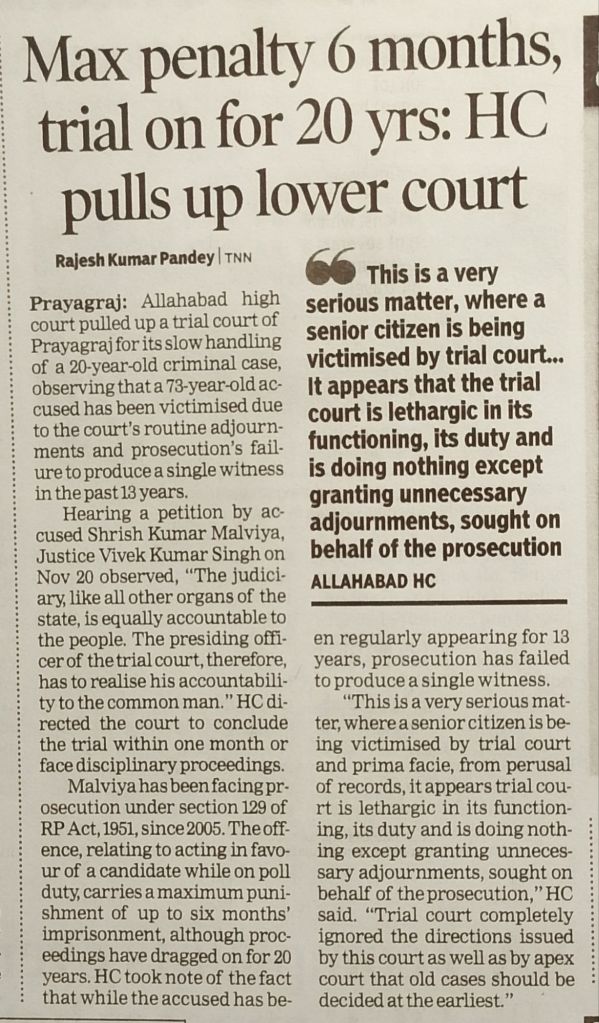
High courts grant directions to expedite cases for compelling reasons, but they generally prefer to have the lower court first consider an application for expedited disposal. To get a High Court’s direction, you must file a petition explaining the urgency, though the court must be careful not to upset the lower court’s calendar by creating unwarranted priority for one case. The Supreme Court also requires High Courts to develop Standard Operating Procedures (SOPs) for managing cases where it has previously issued directions to expedite a trial. [1, 2, 3, 4, 5]
How to get a direction to expedite a case
• File an application in the lower court first: A common first step is to file an application in the court where the case is pending, requesting an expedited hearing and stating the reasons for urgency. This was the recommended action in one case where the petitioner was a senior citizen.
• File a petition in the High Court: If the lower court does not act, you can file a petition in the High Court seeking a direction to the lower court to expedite the case.
• Provide compelling reasons: The High Court will only issue an expedited order for “extremely compelling reasons,” such as an inordinate delay in the case’s progress. You will need to demonstrate a strong case for urgency.
• Be aware of procedural hurdles: High Courts are cautious about granting expedited orders because it can disrupt the lower court’s calendar and give unfair priority to one case. [1, 3, 4, 5, 6]
What the Supreme Court is doing
• The Supreme Court has directed all High Courts to create a Standard Operating Procedure (SOP) for monitoring cases in which the Supreme Court has previously issued directions to expedite a trial.
• This SOP aims to create a more structured process for handling these cases across all High Courts. [2]
What High Courts look for
• Circumstances of the case: The High Court will consider the totality of the circumstances, not just the request for a speedier trial.
• Avoids mechanical orders: The court will avoid issuing automatic directions to expedite cases. It is for the lower court judge to apply their mind and decide if the case should be expedited.
• Strong justification: The High Court will not issue expedited orders without compelling reasons. [1, 3, 4]
AI responses may include mistakes.
[1] https://elegalix.allahabadhighcourt.in/elegalix/WebShowJudgment.do?judgmentID=7555319
[2] https://www.facebook.com/barandbench/posts/the-supreme-court-recently-directed-the-high-courts-across-india-to-prepare-a-st/1083686970474082/
[3] https://elegalix.allahabadhighcourt.in/elegalix/WebDownloadOriginalHCJudgmentDocument.do?translatedJudgmentID=4341
[4] https://www.livelaw.in/top-stories/directions-to-expedite-trial-in-a-particular-case-must-be-passed-only-for-extremely-compelling-reasons-supreme-court-194532
[5] https://lawrato.com/civil-legal-advice/how-to-expedite-civil-court-proceedings-245457
[6] https://www.kaanoon.com/106735/how-to-expedite-criminal-matter
 Latest Legal News, Stories & Updates by LegalSeva