The Punjab and Haryana High Court has reiterated that courts and tribunals cannot ignore glaring contradictions in evidence and must not adopt an “ostrich-like approach” by overlooking material facts while deciding compensation claims.
Background of the Case
The case arose from a motor accident that occurred in May 2015 near Kalka, in which a 24-year-old man, Summit, lost his life. His parents filed a claim petition before the Motor Accident Claims Tribunal (MACT), Kurukshetra, seeking compensation of ₹60 lakh, alleging that the accident was caused due to the rash and negligent driving of a car driven by one Surender.
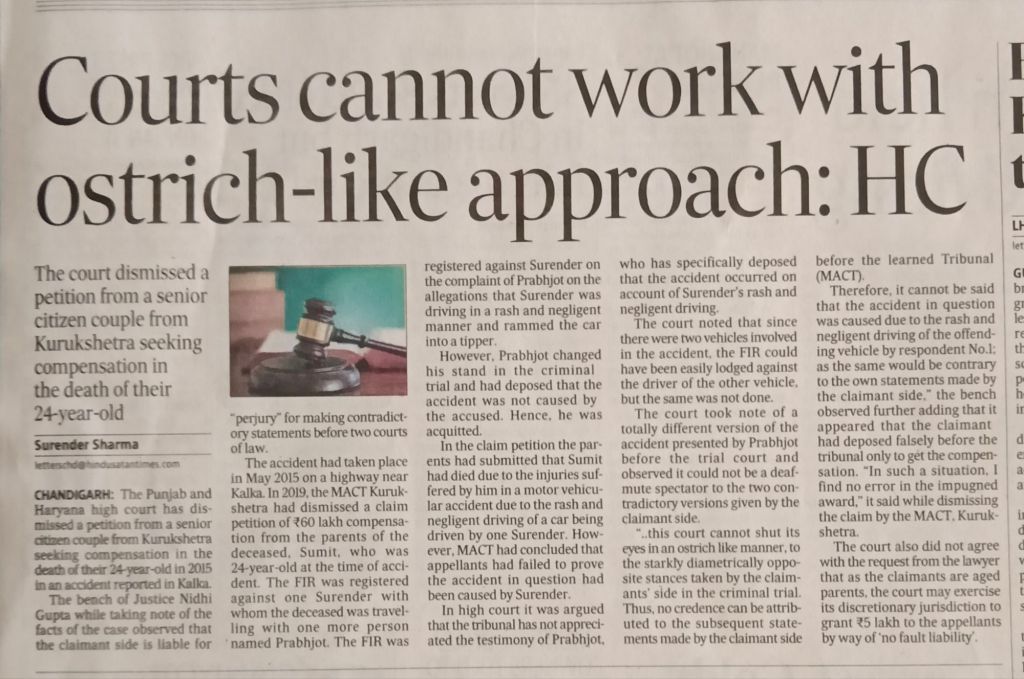
An FIR was registered against Surender on the complaint of Prabhjot, who was travelling in the same vehicle. However, during the criminal trial, Prabhjot changed his version and stated that the accident was not caused by the accused. As a result, Surender was acquitted in the criminal proceedings.
Findings of the MACT
The MACT dismissed the compensation claim, holding that the claimants failed to prove that the accident occurred due to the rash and negligent driving of the respondent. The tribunal noted serious contradictions between the versions presented in the criminal trial and the claim proceedings.
High Court’s Observations
While dismissing the appeal filed by the parents, the High Court observed that the claimants’ side had taken diametrically opposite stands in different proceedings. The Court emphasized that it could not act as a “mute spectator” to such contradictions.
The Court held that:
When two vehicles were involved in the accident, the FIR could have been lodged against the driver of the other vehicle as well, but no such step was taken.
Statements made in the criminal trial directly contradicted the version presented before the MACT.
Subsequent statements made solely to secure compensation could not be relied upon.
The bench categorically stated that courts cannot shut their eyes in an ostrich-like manner to material inconsistencies and false depositions.
No Relief Under No-Fault Liability
The High Court also declined the request to grant compensation under the “no fault liability” principle, despite the claimants being aged parents, holding that no legal error was found in the MACT’s decision.
Conclusion
This judgment reinforces an important legal principle: compensation claims must be founded on consistent, credible, and truthful evidence. Courts and tribunals are duty-bound to scrutinize contradictions and cannot overlook false or shifting versions merely on sympathetic grounds.
 Latest Legal News, Stories & Updates by LegalSeva