Yes — the Punjab & Haryana High Court (which sits at Chandigarh) regularly hears and decides pre-arrest bail (anticipatory bail) applications under the criminal procedure regime (currently BNSS 2023, similar in operation to old CrPC Section 438). Here’s a reliable summary of relevant case examples and principles from recent decisions:
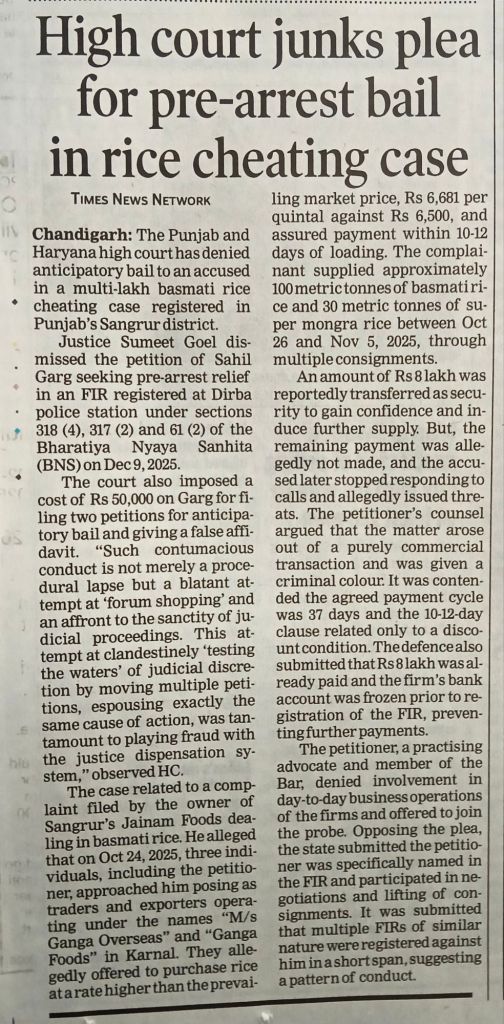
📌 Recent High Court Decisions on Pre-Arrest Bail (Anticipatory Bail) in Chandigarh
1. Grant of Interim Pre-Arrest Bail
- The Court recently granted interim anticipatory bail to an accused in an assault case arising out of a neighborhood dispute, allowing him protection in the event of arrest while the petition is adjourned.
2. Grant of Interim Anticipatory Bail in Missing Saroop FIR
- The High Court granted interim anticipatory bail to a 61-year-old accused in a case involving alleged unauthorised handling of holy scriptures, directing release upon arrest on furnishing bonds and compliance with investigative directions.
3. Refusal of Pre-Arrest Bail
- In another recent matter, the High Court denied anticipatory bail where the alleged offence was seen as a threat to public order/communal peace, holding that exceptional relief was not warranted.
4. Denials in Serious Economic Offence Cases
- The Court has also refused pre-arrest bail in high-profile corruption and economic offence cases (e.g., involving large public funds), emphasising gravity and prima facie evidence.
5. Challenged Grants of Anticipatory Bail
- In Shinderpal Kaur v. State of Punjab & Anr., a High Court order granting anticipatory bail was set aside on appeal on grounds that bail was not warranted given the circumstances — showing the appellate scrutiny of such grants.
📌 Legal Principles Applicable in the High Court
🟢 Statutory Basis
- Anticipatory bail is governed by Section 482 BNSS 2023 (analogous to Section 438 CrPC principles) — empowering the High Court to grant pre-arrest bail to persons fearing arrest in non-bailable offences.
🧠 Criteria Considered by the Court
Like in Supreme Court precedent (Gurbaksh Singh Sibbia v. State of Punjab and Sushila Aggarwal v. State (NCT of Delhi)), Punjab & Haryana High Court weighs:
- Nature and gravity of the offence
- Probability of evidence tampering / witness influence
- Antecedents of accused & criminal history
- Likelihood of fleeing from justice
- Whether bail would impede investigation
These criteria guide whether pre-arrest bail is appropriate in each case.
⚖️ Interim vs. Final Conditions
- Courts often grant interim protection first (direction not to arrest pending full hearing) with conditions like bond, sureties, cooperation in investigation, non-interference with witnesses, etc.
📌 Practical Example Case Names / Situations (Chandigarh HC)
Case / Situation Order Type Key Considerations Interim anticipatory bail for assault accused (Sonipat) Interim pre-arrest bail Investigation ongoing, limited prima facie culpability Interim anticipatory bail in “missing saroop” FIR Interim pre-arrest bail Age of accused, documentary evidence gaps Denial in communal threat case Pre-arrest bail refused Seriousness, public order concerns Denial in corruption scam Pre-arrest bail refused Gravity of economic offence Shinderpal Kaur v. State of Punjab High Court anticipatory bail set aside on appeal Bail not warranted on facts; appellate review valid
📌 Supreme Court Principles Often Adopted
Although not specific to Chandigarh, the Punjab & Haryana High Court routinely follows Supreme Court guidelines on anticipatory bail, notably:
- Gurbaksh Singh Sibbia v. State of Punjab — foundational anticipatory bail principles
- Sushila Aggarwal v. State (NCT of Delhi) — anticipatory bail not to be given as blanket protection and conditions can be imposed
These shape how the High Court applies its discretion under Section 482 BNSS.
 Latest Legal News, Stories & Updates by LegalSeva