Supreme Court: Compensation Cannot Replace Punishment – A Strong Message to High Courts
In a significant ruling reinforcing the principles of criminal justice, the Supreme Court of India has made it clear that financial compensation to victims cannot be treated as a substitute for punishment. The Court strongly criticized the growing trend of reducing sentences merely because the accused agreed to pay money to the victim.
This judgment sends a powerful message to lower courts and society at large: justice cannot be “bought.”
—
Background of the Case
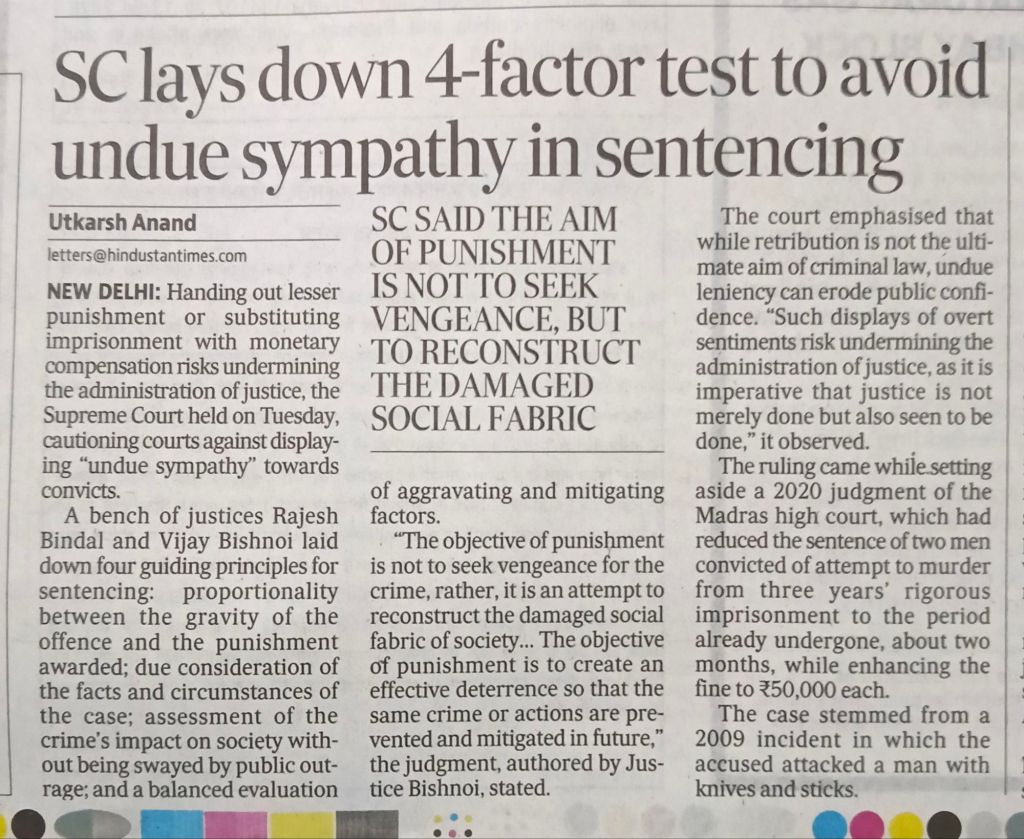
The ruling came while setting aside an order of the Madras High Court, which had reduced a three-year jail sentence in an attempt-to-murder case to the period already undergone—just two months—after the convicts agreed to pay ₹50,000 each to the victim.
A bench comprising Justice Rajesh Bindal and Justice Vijay Bishnoi ruled that such an approach undermines the very foundation of criminal jurisprudence.
—
Compensation Is Restorative, Not Punitive
The Supreme Court emphasized a crucial distinction:
Compensation is restorative in nature
Punishment is punitive and deterrent in character
Compensation aims to rehabilitate the victim—to address the injury, loss, or suffering caused by the crime. However, punishment serves a larger social purpose: it deters crime, upholds the rule of law, and reinforces public confidence in the justice system.
The Court clarified that allowing offenders to escape meaningful imprisonment by paying money sends a dangerous signal—that crimes can be settled financially.
—
Why This Practice Is Problematic
The Supreme Court expressed concern over what it termed a “misplaced understanding” by some High Courts in treating compensation as a ground for reducing sentences.
1. Erosion of Deterrence
If criminals can reduce jail time by offering compensation, the deterrent effect of criminal law weakens.
2. Public Trust in Justice System
Leniency based purely on financial payment risks eroding public faith in courts. Justice must appear fair and firm—not negotiable.
3. Social Message
Criminal law sends a moral message to society. The Court observed that violations of law cannot simply be “purchased away” with money.
—
The Core Objective of Punishment
The bench explained that sentencing must strike a balance:
It should not be excessively harsh.
But it must not be so lenient that it undermines deterrence.
The objective of punishment is not vengeance, but protection of social order and reconstruction of the damaged social fabric. When courts reduce sentences disproportionately, especially in serious crimes like attempt to murder, they risk weakening the authority of law.
—
Victim Compensation: Important but Separate
The Supreme Court did not diminish the importance of victim compensation. In fact, it acknowledged that victimology—the recognition of victims’ rights—is an essential component of modern criminal law.
However, it clarified that:
Compensation should supplement punishment.
It should not replace punishment.
In serious offences, reducing imprisonment solely because compensation has been paid distorts the sentencing framework and may lead to inconsistent judicial standards.
—
A Warning Against Mechanical Sentence Reduction
The Court noted a concerning trend where High Courts reduce sentences “capriciously and mechanically,” sometimes without detailed reasoning. Such reductions must be based on sound judicial principles, not merely on compromise or financial settlement.
This ruling reinforces that sentencing requires careful application of judicial mind, consideration of gravity of offence, societal impact, and proportionality.
—
Legal and Practical Implications
This judgment has far-reaching consequences:
✔ Strengthening Sentencing Principles
Courts must now be cautious while reducing sentences on the basis of compensation.
✔ Reinforcing Rule of Law
The decision upholds the idea that justice cannot be commodified.
✔ Clarity in Criminal Jurisprudence
It clearly separates:
Civil liability (compensation)
Criminal liability (punishment)
✔ Deterrence in Serious Crimes
Particularly in grave offences like attempt to murder, courts must ensure that punishment reflects the seriousness of the act.
—
Key Takeaways for Legal Practitioners
For advocates and litigants, this ruling highlights:
Compensation alone is unlikely to justify sentence reduction in serious offences.
Sentencing arguments must focus on mitigating factors beyond financial settlement.
Judicial discretion in sentencing is not unlimited; it must align with established principles.
—
Conclusion
The Supreme Court’s ruling reaffirms a foundational principle of criminal law: punishment cannot be substituted by payment.
While victim compensation is vital and necessary, it cannot absolve offenders of their penal consequences. Justice must balance victim relief with societal deterrence.
In a justice system already under scrutiny for delays and inconsistencies, this decision restores clarity and sends a strong message—criminal accountability is not for sale.
 Latest Legal News, Stories & Updates by LegalSeva