High Court: Complainant Cannot Intervene as Party in Service Dispute Proceedings
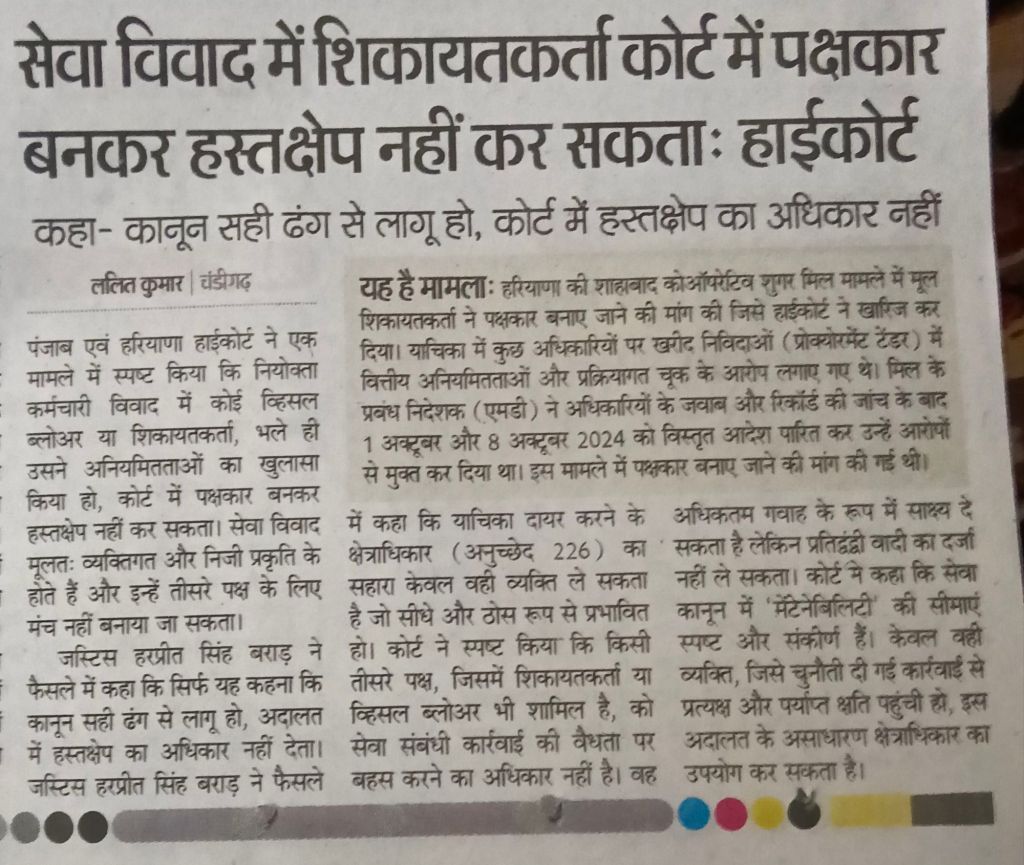
In an important ruling clarifying the scope of judicial intervention in service matters, the Punjab and Haryana High Court has held that a complainant or whistleblower cannot seek to become a party in court proceedings arising out of an employer-employee service dispute.
The Court emphasized that service disputes are essentially personal in nature and cannot be converted into platforms for third-party intervention.
—
Background of the Case
The matter arose from a dispute involving officials of a cooperative sugar mill in Haryana. A complainant had alleged financial irregularities and procedural lapses in procurement-related matters. Following an inquiry, the Managing Director passed orders on October 1 and October 8, 2024, granting relief to the officials concerned.
The complainant then approached the High Court seeking to be impleaded (added as a party) in the service-related proceedings to challenge the validity of the action taken.
—
High Court’s Observations
The Court, while rejecting the request, clarified that:
Service disputes are primarily between employer and employee.
A third party, even if claiming to have exposed irregularities, does not automatically acquire the right to intervene.
Only a person who is directly and substantially affected by the impugned action can seek relief under Article 226 of the Constitution.
The Court further observed that merely asserting that the law must be correctly implemented does not grant a complainant the right to participate as a litigating party in service matters.
—
Scope of Judicial Review in Service Matters
The High Court explained that the extraordinary jurisdiction under Article 226 can be invoked only by a person who:
Suffers direct and substantial injury, and
Is personally aggrieved by the administrative action.
A complainant or whistleblower, who is not directly impacted by the service decision, cannot claim locus standi to challenge it.
The Court also highlighted that “maintainability” in service law is narrow and specific, and courts cannot expand the scope to include third parties without legal standing.
—
Legal Significance of the Judgment
This ruling reinforces three important principles:
1. Service disputes remain confined to employer-employee relationships.
2. Third parties cannot transform service litigation into public interest proceedings.
3. Locus standi is essential for invoking writ jurisdiction.
The judgment ensures that courts do not become arenas for indirect or collateral challenges by individuals who are not directly affected by service decisions.
—
Conclusion
The Punjab and Haryana High Court’s decision serves as a reminder that while whistleblowers and complainants may raise concerns before competent authorities, they cannot claim the status of a party in service-related court proceedings unless they demonstrate direct legal injury.
This ruling strengthens the doctrine of locus standi and preserves the limited scope of judicial intervention in service disputes.
—
More on 99888-17966
 Latest Legal News, Stories & Updates by LegalSeva