Disability Percentage Alone Cannot Decide Job Eligibility: Supreme Court
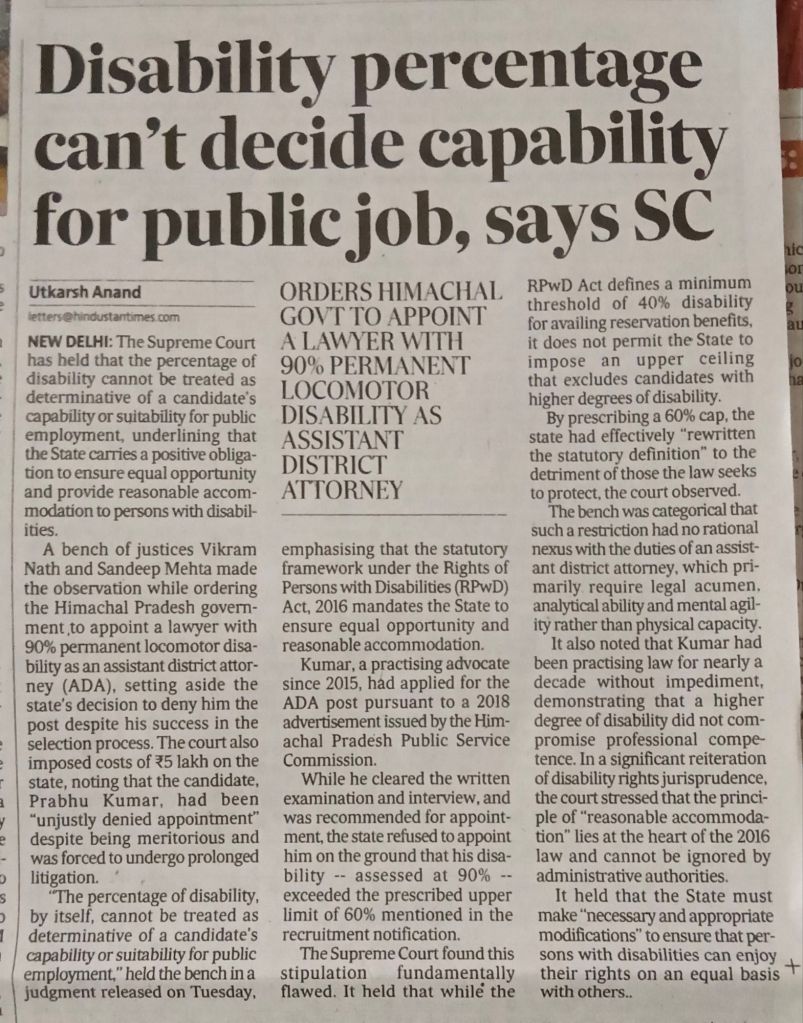
In a landmark ruling, the Supreme Court has clarified that the percentage of disability cannot be the sole criterion to determine a candidate’s capability or suitability for public employment. The judgment reinforces the principles of equality and reasonable accommodation under disability law.
Background of the Case
The case involved a practicing advocate, Prabhu Kumar, who had applied for the post of Assistant District Attorney (ADA) in Himachal Pradesh.
Despite successfully clearing the written exam and interview, he was denied appointment because his 90% locomotor disability exceeded the state-prescribed upper limit of 60%.
Supreme Court’s Key Observations
A bench of Justices Vikram Nath and Sandeep Mehta held that:
Disability percentage cannot be treated as determinative of a person’s capability
The State has a positive obligation to ensure equal opportunity
Authorities must provide reasonable accommodation to persons with disabilities
The Court emphasized that imposing an upper cap on disability goes against the spirit of the Rights of Persons with Disabilities (RPwD) Act, 2016.
Violation of Legal Principles
The Court noted that:
The RPwD Act sets a minimum threshold of 40% disability for reservation benefits
However, it does not permit an upper limit to exclude candidates
The state’s 60% cap effectively rewrote the law, which is impermissible
Focus on Capability, Not Disability
Importantly, the Court observed that the role of an Assistant District Attorney primarily requires:
Legal knowledge
Analytical ability
Mental agility
Physical limitations, in this context, were not relevant to job performance.
The Court also highlighted that the candidate had been practicing law for nearly a decade without any professional hindrance.
Court’s Direction
The Supreme Court:
Directed the Himachal Pradesh government to appoint the candidate
Imposed a cost of ₹5 lakh on the State for unjust denial
Stressed the need for policy corrections to ensure inclusivity
Conclusion
This judgment is a strong affirmation of disability rights in India. It makes it clear that ability should be judged by competence, not by percentage of disability.
The ruling sets an important precedent, urging authorities to adopt a more inclusive and rights-based approach in public employment.
More on 99888-17966
 Latest Legal News, Stories & Updates by LegalSeva