A Magistrate can order the registration of a First Information Report (FIR) under Section 156(3) of the Code of Criminal Procedure (CrPC)—now Section 175(3) of the Bharatiya Nagarik Suraksha Sanhita (BNSS)—when a cognizable offence is disclosed, and the police have failed to act. This power is a judicial remedy to ensure police accountability. [1, 2, 3]
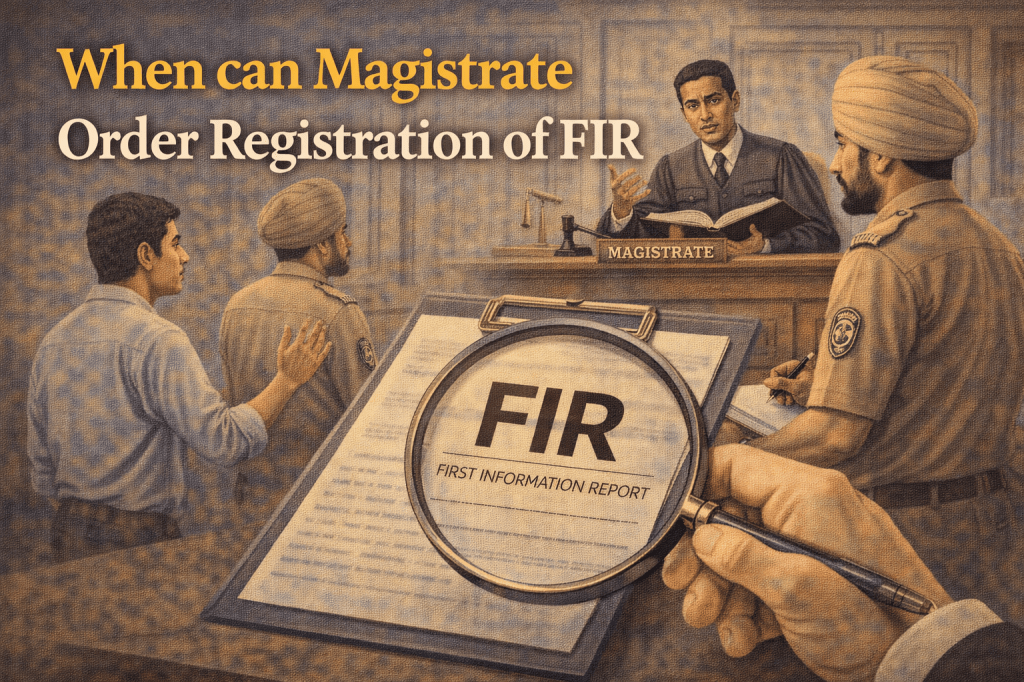
Here are the specific conditions and situations when a Magistrate can pass such an order:
1. Key Conditions for Magisterial Intervention
• Refusal by Police (Section 154(1)): When a complaint reporting a cognizable offence is presented to the police, and they refuse to record it.
• Failure of Senior Police Officers (Section 154(3)): When, after refusal by the local police, the complainant has submitted the complaint in writing to the Superintendent of Police (SP) or equivalent officer, and they also fail to act.
• Prior Filing of Affidavit: A recent legal requirement (Priyanka Srivastava case) is that the complaint filed before the Magistrate must be supported by an affidavit confirming that the complainant has already approached the police/SP.
• Cognizable Offence: The complaint must show that a serious crime (cognizable offence, such as murder, theft, or rape) has been committed.
• Pre-cognizance Stage: The Magistrate orders this before formally taking cognizance of the offence (before the trial starts) to initiate investigation. [4, 5, 6, 7, 8, 9]
2. Situations When the Order is Passed
• Inaction by Police: Where police refuse to register an FIR despite a clear case of a cognizable offence.
• Inadequate/Improper Investigation: If the police have registered an FIR but are conducting a superficial, biased, or negligent investigation.
• Serious Offences: In cases where an urgent, high-level investigation is required, and the magistrate deems it necessary. [6, 8, 9]
3. Procedure and Guidelines
• Meaningful Application of Mind: The Magistrate is not meant to act as a “post office” and must apply their mind to the facts, not mechanically order an FIR.
• Not Bound in All Cases: While the power is extensive, it should be used sparingly, not in frivolous cases.
• No Bar to Prior Remedies: In a 2025 judgment (Om Prakash Ambadkar), the Supreme Court noted that while exhaustion of remedies (approaching the SP) is required, non-compliance doesn’t automatically invalidate the order if the magistrate applied their mind.
• Time-bound Investigation: The Magistrate can order the investigation to be completed in a specified timeframe. [4, 10, 11, 12, 13]
4. Important Legal Principles
• Judicial Accountability: The Supreme Court has clarified that if the Magistrate does not pass a speaking order (reasoned order) and simply directs an FIR, it can be set aside.
• No Revision: An order passed by a Magistrate under Section 156(3) is an interlocutory order, meaning the accused cannot easily challenge it via a revision petition in higher courts. [12, 14]
If the Magistrate refuses to pass an order under Section 156(3), the complainant has the alternative to file a direct complaint under Section 200 of the CrPC to initiate a magistrate-led inquiry. [9]
AI can make mistakes, so double-check responses
[1] https://patnahighcourt.gov.in/bja/PDF/UPLOADED/BJA/BLOGSJUDGMENT/1.PDF
[2] https://www.courtkutchehry.com/pages/blog/supreme-court-magistrate-fir-registration-section-156-3-crpc-judgment/
[3] https://www.linkedin.com/pulse/registration-fir-first-information-report-vijay-pal-dalmia-8bncc
[4] https://www.scobserver.in/supreme-court-observer-law-reports-scolr/sadiq-b-hanchinmani-v-state-of-karnatakamagistrates-power-to-order-an-fir-under-section-1563-crpc/
[5] https://www.livelaw.in/supreme-court/s-1563-crpc-once-complaint-discloses-cognizable-offence-magistrate-can-direct-police-to-register-fir-supreme-court-308911
[6] https://www.legalbites.in/bharatiya-nagarik-suraksha-sanhita/can-a-magistrate-direct-the-police-to-register-an-fir-when-a-complaint-discloses-a-cognizable-offence-1208954
[7] https://pinklegal.in/topics/police/fir.html
[8] https://www.jaagore.com/articles/know-your-police/What-To-Do-If-The-Police-Refuse-To-Register-An-FIR
[9] https://www.lexology.com/library/detail.aspx?g=7018bbd4-5cf0-46d2-9097-ef972ce56329
[10] https://lawhelpline.in/wp-content/uploads/2024/01/Sec._1563.pdf
[11] https://qualegalindia.com/judicial-scrutiny-fir-registration-bnss-vs-crpc.html
[12] https://www.verdictum.in/court-updates/high-courts/pre-conditions-must-be-satisfied-when-directing-registration-of-fir-under-section-156-3-crpc-delhi-high-court-1486067
[13] https://lawhelpline.in/wp-content/uploads/2026/02/FIR-under-Section-1563-CrPC.pdf
[14] https://www.scconline.com/blog/post/2025/12/27/magistrates-order-directing-fir-registration-not-open-to-revision-at-proposed-accused-instance-all-hc/
More on 99888-17966
 Latest Legal News, Stories & Updates by LegalSeva