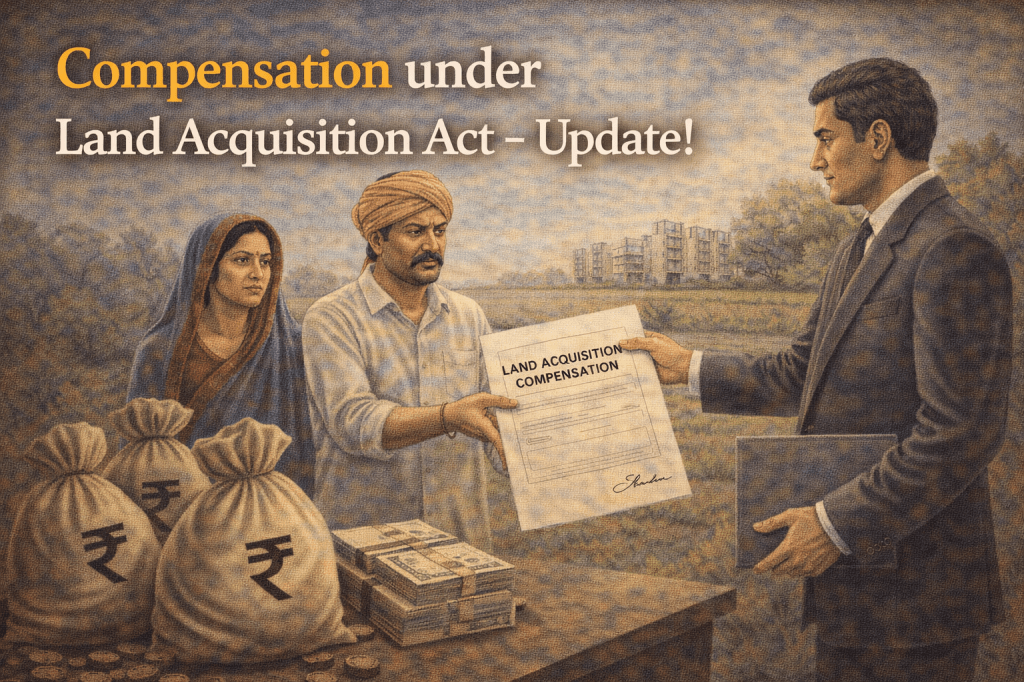
Under the Right to Fair Compensation and Transparency in Land Acquisition, Rehabilitation and Resettlement Act, 2013 (LARR), compensation for acquired land is calculated as twice the market value in urban areas and up to four times in rural areas, including rehabilitation and resettlement for affected families. The compensation calculation accounts for the highest market value, solatium (compensation for pain/suffering), and 12% interest from the date of notification, with 80% consent required for private projects. [1, 2, 3, 4]
Key Components of Land Acquisition Compensation (LARR Act, 2013)
• Market Value Assessment: The compensation is based on the higher of the average sale price of similar land in the area or the minimum value under the Stamp Act.
• Multiplier Factor: In rural areas, the market value is multiplied by a factor (1–2), making compensation up to four times the market value.
• Solatium: A mandatory amount, typically 100% of the compensation value, is added to the compensation package to account for the compulsory nature of the acquisition.
• Rehabilitation & Resettlement (R&R): The law mandates rehabilitation and resettlement for affected families, including those without land ownership (such as workers or tenants).
• Assets Attached to Land: Compensation includes the value of trees, wells, or buildings, which are valued based on reports from technical authorities. [1, 2, 3, 5]
Compensation Procedures and Rights
• Social Impact Assessment (SIA): Before acquisition, an assessment is done to check if the benefits of the project outweigh the social costs.
• Timeline & Notice: Landowners are given notice to produce documents and can file objections to the proposed acquisition.
• Appeals: If the compensation amount is deemed inadequate, affected persons have the right to appeal for a higher amount.
• Tax Exemption: Compensation received for land acquisition is generally exempt from income tax, stamp duty, and registration fees. [4, 6, 7]
Special Conditions
• Government Projects: No consent is required for government-led projects.
• Private/PPP Projects: Consent of 80% of affected people is required for private companies, and 70% for Public-Private Partnership (PPP) projects.
• Special Compensation Cases: In certain exemptions from SIA, a minimum of ₹50,000 to ₹5,00,000 is given to each landowner. [1, 4, 8]
This information is based on the 2013 LARR Act in India. [1, 6]
AI can make mistakes, so double-check responses
[1] https://prsindia.org/billtrack/the-right-to-fair-compensation-and-transparency-in-land-acquisition-rehabilitation-and-resettlement-bill-2013
[2] https://cag.gov.in/uploads/download_audit_report/2024/14.-Chapter-4—Copy-066e27b7be89da9.68057545.pdf
[3] https://lawbhoomi.com/land-acquisition-compensation/
[4] https://prsindia.org/billtrack/the-right-to-fair-compensation-and-transparency-in-land-acquisition-rehabilitation-and-resettlement-second-amendment-bill-2015
[5] https://ksandk.com/newsletter/parameters-compensation-land-acquisition/
[6] https://www.indiacode.nic.in/bitstream/123456789/19895/1/the_right_to_fair_compensation_and_transparency_in_land_acquisition,_rehabilitation_and_resettlement_act,_2013..pdf
[7] https://community.verified.realestate/article/how-to-claim-compensation-for-government-acquired-land-a-complete-guide/
[8] https://kandaya.karnataka.gov.in/74/land-aquazation/en
 Latest Legal News, Stories & Updates by LegalSeva